
Home / Replacement and Retrofits
Commercial HVAC and rooftop unit replacement
We replace and retrofit equipment in existing buildings: rooftop and package units, chillers, boilers, air handlers and cooling towers. We only recommend it once repairing the old unit has stopped being the economical choice, and we plan the swap around your building instead of the other way around.
Repair until it is no longer economical, then replace
George Blevens puts it simply: keep it running as long as possible, until it is monetarily not feasible. That is the order we work in. George has followed behind companies that told a customer the whole unit had to go, found the actual fault, repaired it and had the equipment back online, then told the owner to remember us when replacement really did come due.
So when we recommend replacing a rooftop unit or a chiller, it is because the numbers have turned, not because replacing is easier to sell. We are solution oriented, not sales oriented, and a replacement proposal from us comes with the reasons written down.
How we make the repair-or-replace call
| What we weigh | What it tells us |
|---|---|
| Age against expected life | ASHRAE's median service life figures: rooftop units about 15 years, reciprocating chillers about 20, centrifugal chillers about 23, galvanized cooling towers about 20, steel firetube boilers about 25, cast iron boilers about 35. A unit well past its median is living on borrowed time, even if it runs today. |
| Repair history | One compressor in 18 years is normal wear. Three major repairs in two summers usually means the next one is coming. |
| Parts availability | Discontinued boards, motors and heat exchangers can often be found, cross-referenced or adapted. When they cannot, or the lead time leaves a building without cooling for weeks, the math changes. |
| Refrigerant | R-22 is no longer produced in the United States, so older systems depend on reclaimed refrigerant. A small top-off can still make sense. A major leak or a failed compressor on an R-22 system usually tips the decision toward replacement. |
| The building today | A space that went from storage to offices, or a line that added a heat load, may have outgrown the unit that serves it. Replacing like for like would repeat the problem. |
You get both sides in writing: what the repair costs and what it buys you, and what replacement involves. Then the call is yours.
Like for like, or a retrofit
A like-for-like replacement puts in a new unit of the same capacity and configuration, connected where the old one was connected. It is the fastest route when the old unit was sized correctly and the building has not changed.
A retrofit changes something on purpose. That might mean resizing a rooftop unit to the load the space carries now, adding an economizer or variable speed fan control, moving from electric heat to gas heat, replacing a failed compressor section and controls while keeping a sound cabinet and coil, or putting modern controls on older equipment that still has good years in its mechanical parts. Retrofits are also how we deal with equipment the manufacturer no longer supports: keep what is sound, replace what cannot be sourced.
What a rooftop unit replacement day looks like
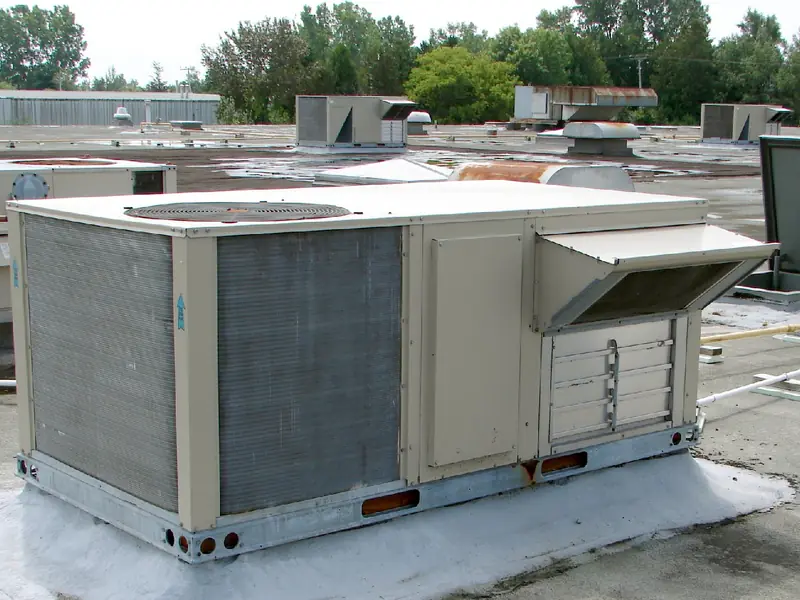
Most of the work on a rooftop unit swap happens before the crane shows up. We match the new unit to the existing roof curb, and when the footprint is different, we use a curb adapter that sits on the old curb and fits the new unit, so the roof opening and the roofing around it can stay as they are.
The crane lift gets planned around the site: where the crane can set up, what parking or drive lanes need to be closed, and what time of day keeps people clear of the lift. Early mornings and weekends are common for retail and office buildings; plants often pick a shutdown or a slow shift.
On the day, the old unit is shut down and locked out, the refrigerant is recovered, and power, gas, condensate and control wiring are disconnected. The old unit comes off, the new one goes on, everything is reconnected, and the unit is started up and checked under load before we leave. Every piece of that scheduled shutdown is agreed with your team ahead of time, including temporary cooling for any space that cannot go without it. After that, the new unit gets the same rooftop unit service and repair we do on package units from 2 to 120 tons.
Chillers, boilers and cooling towers
Replacing a central plant component takes more planning than a rooftop unit. A chiller replacement can mean rigging through a mechanical room, a temporary rental chiller to carry a process load, and piping changes to fit the new machine. A boiler replacement is best done between heating seasons, and a cooling tower replacement before the cooling season starts. We lay out the sequence, the shutdown window and the temporary plan before anything is ordered.
A 1-year installation warranty, plus the manufacturer's
Every replacement we install carries our 1-year installation warranty (some call it a workmanship warranty) and the manufacturer's equipment warranty, whichever runs longer.
We also take over equipment when the original installer's warranty ends. Keeping existing equipment running for years is the kind of work we are built for, so a replacement we put in is equipment we expect to be servicing for a long time.
Planned replacements, on your budget cycle
The best time to replace a unit is before it fails: in the spring or fall, when the building can go a day without cooling or heat, with the new equipment already on order. Our maintenance agreement reports flag the units nearing the end so the replacement lands in next year's budget. When several pieces of equipment are aging at once, we rank them by condition and risk so the money goes where it matters first.
We replace equipment across the towns and counties we cover in Middle Tennessee, from Nashville to commercial buildings in Murfreesboro, Smyrna and La Vergne.
Replacement questions
ASHRAE's median service life for rooftop units is about 15 years. Units that are maintained well and not undersized for their load often run longer. Age alone is not a reason to replace one; age plus repair history, parts and refrigerant usually is.
Often, yes. If the new unit's footprint matches, it sets straight on the old curb. If not, a curb adapter bridges the difference so the roof opening does not have to be changed.
Usually not. Only the area served by the unit being replaced loses cooling or heat, and we schedule that shutdown around your hours. Critical rooms get a temporary cooling plan before the old unit comes off.
Our 1-year installation warranty plus the manufacturer's equipment warranty, whichever runs longer.
Before and after the swap
Tell us which unit is at the end of the line
The make, model, tonnage and age of the unit, plus its recent repair history, let us tell you whether it is time.
- Phone, 24/7 for emergencies(615) 814-6338
- EmailService@britemech.com