
Home / Service and Repair / Rooftop Units
Rooftop unit repair and service
A large share of commercial buildings in Middle Tennessee are heated and cooled by package units sitting on the roof, out of sight until a tenant calls about the temperature. We repair and maintain rooftop and package units from 2 tons on a strip-center suite up to 120-ton units on large buildings, any brand, gas heat or heat pump.
RTU · service plate
- Size
- 2 to 120 tons
- Heat
- Gas-fired, heat pump, electric
- Compressors
- Scroll, tandem scroll, semi-hermetic
- Air side
- Blowers, belts, economizers
- Makes
- All brands, old and new
- After hours
- 24/7 emergency line
One cabinet, a whole mechanical room
A rooftop unit packs everything a building needs into one weatherproof box: compressors, a condenser coil and fans, an evaporator coil, a supply blower on a belt drive, a heat section, an economizer for outdoor air, and the controls that run them all. That makes rooftop units cheap to install and easy to forget. It also means one failed part, a worn belt or a pitted contactor, can take a whole suite or a whole sales floor off comfort.
We treat the unit as a system. A compressor that trips on high pressure is often the victim of a dirty condenser coil or a seized fan motor, and a unit that "runs but doesn't cool" may have a broken belt, a stuck economizer or a frozen evaporator coil instead of a refrigerant problem.
Rooftop unit faults we find most
| What you see | What is usually behind it |
|---|---|
| Fan runs, air is warm | A compressor off on a safety, a failed contactor or capacitor, low refrigerant charge, or a condenser fan motor that quit. |
| No airflow at the diffusers | A broken or slipping blower belt, a failed blower motor or bearing, or filters loaded so heavily they collapsed. |
| Water on the ceiling tiles | A plugged condensate drain or trap, or an iced evaporator coil melting off all at once. |
| No heat on the first cold morning | Inducer motor, pressure switch, hot surface ignitor, dirty flame sensor, or a heat pump stuck out of defrost. |
| Space stays muggy in summer | An economizer damper stuck open, a bad outdoor air sensor, or a unit too big for the space that short-cycles without pulling moisture out. |
| Breaker trips or unit won't start | A shorted compressor winding, a grounded fan motor, or loose and burnt connections in the control panel. |
Before anything gets reset, we note what the thermostat, the unit controller and the fault lights say. Newer units store fault history, and the first code usually points to the real problem.
Scroll, tandem scroll and semi-hermetic compressors
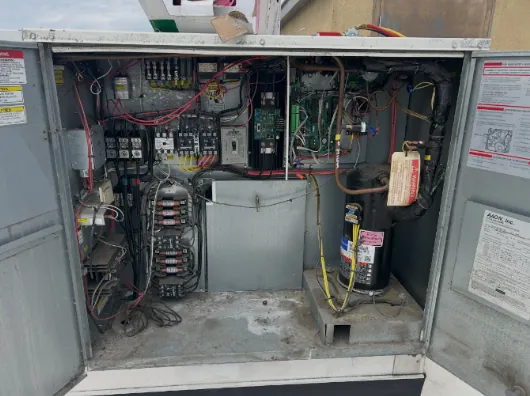
Smaller rooftop units run a single scroll compressor. As units get bigger they add stages: two or more compressors, sometimes piped as a tandem pair on a shared manifold, so the unit can run at half capacity on a mild day and full capacity in July. The largest package units may carry semi-hermetic compressors, which can be opened up and rebuilt rather than thrown away.
Staged units fail in a quieter way than small ones. One compressor drops off on a safety, the other keeps running, and nobody notices until the first 95-degree afternoon when the building cannot keep up. We check every stage, not just the one that happens to be running, and we measure amp draw on each compressor against its nameplate.
When a compressor or a control board is no longer made, that is not the end of the unit. Finding a part that fits, or a way to make one work, is a large share of what we do on older rooftop equipment.
Gas heat, heat pumps and economizers
Gas-fired rooftop units sit idle all summer and then get asked to light on the first cold morning in November. Inducer motors, ignitors, flame sensors and pressure switches are the usual suspects, and we look at the heat exchanger for cracks and rust-through on every heating check. Heat pump units carry their own list: reversing valves, defrost controls and the outdoor coil that has to shed ice all winter.
The economizer is the part most often ignored. When its damper actuator fails open, the unit pulls outdoor air all summer. Nashville averages about 54 days a year at 90°F or hotter, with July dew points around 68°F (NOAA normals, NOAA hourly normals). A stuck-open economizer turns that hot, wet air into load the compressors were never sized for. A stuck-closed one starves the space of fresh air.
Rooftop maintenance, by the season
- Spring: condenser coil cleaning, refrigerant pressures and superheat, compressor and fan motor amps, condensate drain and trap flushed
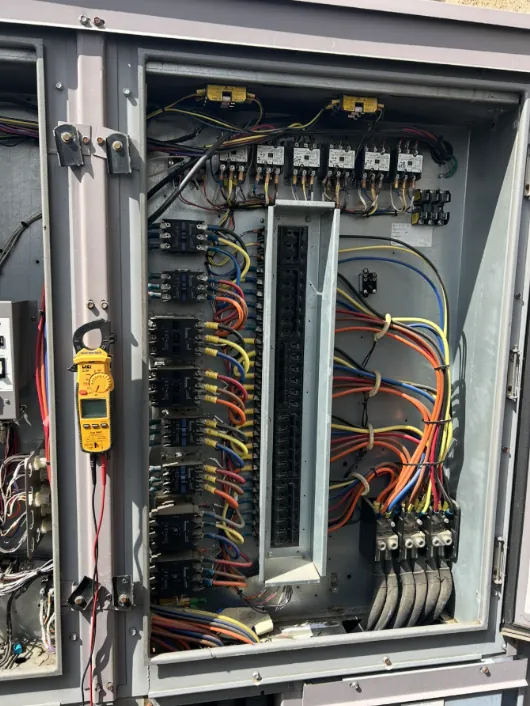
- Every visit: filters, blower belt tension and wear, bearings, contactors, capacitors and wiring connections
- Economizer: damper moves through its full stroke, actuator and outdoor air sensor tested
- Fall: gas heat started and checked, flame sensor cleaned, heat exchanger inspected, heat pump defrost tested
- A written note on each unit: what we found, what we fixed and what is getting close to the end
Buildings with a dozen or more units get the most from a rooftop maintenance agreement. Warehouse corridors show why: the Elm Hill Pike and I-40 submarket alone holds about 33.75 million square feet of industrial space (CBRE, Q4 2025), much of it cooled and heated from the roof. We maintain units across Nashville and Davidson County, the logistics buildings around Lebanon and Wilson County, and the rest of our Middle Tennessee service area.
Repair or replace a rooftop unit?
ASHRAE's median service life estimate for rooftop units is about 15 years, and well-kept units routinely go longer. We are service first, not replacement first: we keep a unit running until repairing it stops making financial sense. That point usually comes with a failed compressor on an old refrigerant, a cracked heat exchanger, or a cabinet and coil rusted beyond saving. When it does, we give you the numbers and plan the rooftop unit replacement around your tenants and your budget, including the curb adapter and crane day. We also take over units once the installer's warranty runs out.
Rooftop unit questions
From 2 tons up to 120-ton package units. Most calls are on the smaller units that cover retail suites, offices and warehouse floors, but we are just as comfortable on the big ones.
Often, yes. We work on older equipment and track down substitute parts or adapt controls when the original part is gone.
At least twice a year, once before cooling season and once before heating season. Filters on dusty sites or busy retail floors need changing more often than that.
Yes. We sort them by what they serve, such as a server closet or a busy sales floor before a storage room, and tell you what each one needs.
After the roof
Rooftop unit blowing warm or not heating?
Send the building address, how many units are acting up, and the tonnage or model if you have it.
- Phone, 24/7 for emergencies(615) 814-6338
- EmailService@britemech.com